“Now that everyone has shifted to work from home, it’s as if we’ve got 10,000 branches,” Goerlich said. “So the techniques we use aren’t scaling, the approaches we use aren’t scaling, we don’t have the manpower, the technology to possibly secure 10,000 branches.”
That added complexity means security approaches that once defined work styles for decades now have to be reconsidered or retired — which means the moat needs a rethink.
“We start to talk about traditional IT as being this environment that had a hard-candy shell around it, or a castle with a moat,” said Kevin Swanson, a Microsoft Surface Specialist. “And you protected all of these outside threats from the things that were important to your business on the inside.
This post is an excerpt from a press article. To see other media mentions and press coverage, click to view the Media page or the News category. Do you want to interview Wolf for a similar article? Contact Wolf through his media request form.

Music originally filled our homes both physically and metaphorically. Radios and phonographs were of polished wood and polished brass. I have a Brunswick Phonograph from this period. It’s larger than my desk. In the 1920s, music was furniture.
A hundred years has completely transformed how we play music. The revolution sparked off in 1934, when Ekco released a radio that shook off the dead wood. Within that spark, there’s a lesson for cybersecurity.
Ekco, or E.K. Cole Ltd. in England, held a design competition. Scores of designers entered. Ekco received scores of designs. At worst, the designs were plastic copies of the furniture. At best, these designs had ornamentation which looked like the radios of the day. Wells Coates entry was a radical departure. But before we get to Coates, let’s talk a bit about the human need to copy what has come before.
Skeuomorph. That’s the design term. Skeuomorphism is one way to take a design one metaphor at a time, by keeping cues that remind people of what came before. A good example today is the Tesla and other electric cars having front grilles, a callback to when air cooled the gasoline engine. Skeuomorphism makes the new feel familiar, but it can also be a trap. Consider that most cars blow air in three directions: feet, face, or defrost. It is a holdover from when a physical tube controlled airflow and the tube only pointed in one direction at a time. Just as there’s no need for a grill, there’s no need for this climate control limitation.
Wells Coates put it this way: “We must not forget that the past all too often obstructs our view of the future.”
Coates looked beyond the past to come up with a round radio, a plastic radio, a radio that came in colors, a radio that was free from skeuomorphism. I wonder how Coates did it. Was it because he was an architect and not a product designer? Was it because, though Canadian, Coates was born in Japan and had traveled the world before he turned 18? Whether being an outsider or having range contributed, or something else, Wells Coates and Ecko redefined the product category. “They started to get a character and identity of their own, a radio-ness about them if you will, that was separate and different from furniture,” designer Dick Powell explained in The Genius of Design. With the Ecko AD-65, “their new identity was forged and off radios went.”
Research into user interface design finds skeuomorphism softens the adoption curve for those familiar with the past products. (See: Affordances and Metaphors Revisited.) But skeuomorph designs don’t do anything for people who are completely new to both the interface and the metaphor.
When protecting the organization, the first question is whether the security capability will be new to the organization or an extension of what’s in place now. If it is an improvement, giving a nod to the past by carrying certain things forward will ease adoption. If it’s completely new, best to throw away the furniture and start fresh.
Let go of the past to design the future.
Ekco AD-65, Designed by Wells Coates
This article is part of a series on designing cyber security capabilities. To see other articles in the series, including a full list of design principles, click here.
Expos and tradeshows never end well. When the show’s over, many become ghost towns. Many more end up in the trash. Annually, the estimate is 600,000 tons of waste. So, it’s no surprise the recyclable People’s Pavilion at Dutch Design Week caught my attention.
The People’s Pavilion also gave me insights into a question people frequently ask: how can security programs get the most out of what they have? The answer is complicated because much of security comes from outside of the security program.
Take the CIS Critical Security Controls, for example. At the time of this article, the current version is 7.1 published last April 2019. As you read through the controls, it becomes obvious most are not owned by the security function. More than half the controls are well-configured IT. IT inventory and configuration, IT monitoring, IT backup and recovery. Add a well-configured perimeter, wired, and wireless network. In fact, it isn’t until the last few controls that security takes a front seat. Awareness training, incident response, and penetration testing. IT is the majority and the priority in the CSC.
In the beginning of my career, security was another word for doing IT right. Well-configured IT. This thinking may make a comeback as misconfigurations are rise as a cause of security breaches. In the Verizon Data Breach Investigations Report (DBIR), they write: “Errors definitely win the award for best supporting action this year. They are now equally as common as Social breaches and more common than Malware, and are truly ubiquitous across all industries. Since 2017, Misconfiguration errors have been increasing” and account for more than 40% of errors in the 2020 report.
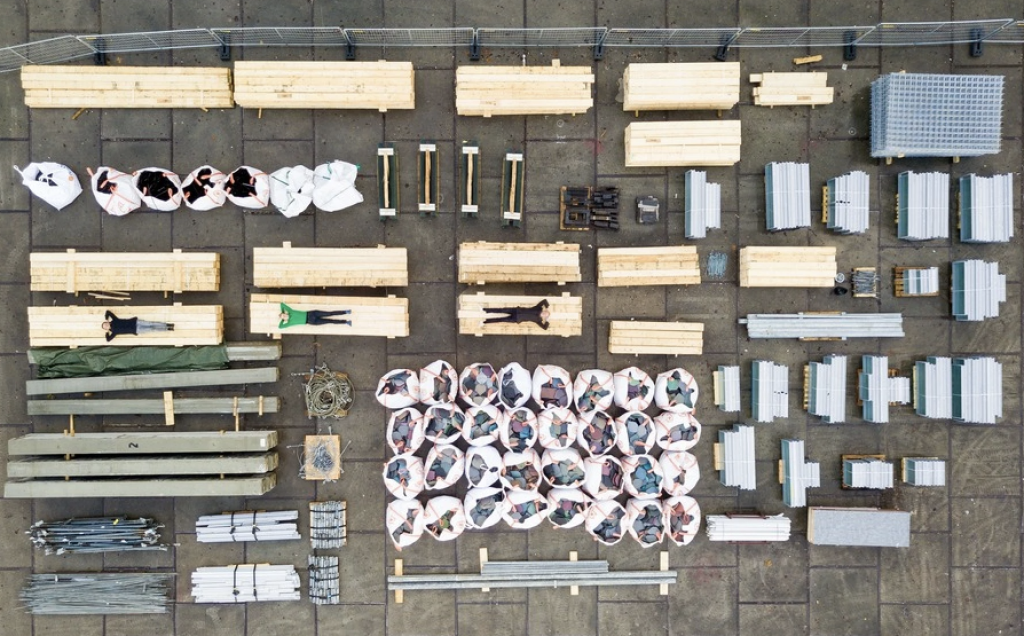
Back to the People’s Pavilion at Dutch Design Week 2017. “The building is a design of bureau SLA & Overtreders W. The designers have given a radical new impulse to the notion of a circular economy: the pavilion is made with 100% borrowed materials. Materials from suppliers and producers, but also from Eindhoven residents. Concrete and wooden beams, facade elements, glass roof, recycled plastic cladding: everything is borrowed for 9 days and will be returned to the owners after the DDW.” To demonstrate nothing went to waste, they photographed all the materials when received and when returned. The images were identical, documenting the full process.
When building and implementing a security capability, consider it like the People’s Pavilion, with a majority of the components coming from the IT team. Determine what those parts are. Determine how they’re supplied (with, for example, SIPOC diagrams.) Determine who will be responsible (with, for example, RASCI charts.) Reduce any waste in building the security capability. And finally, to prepare for future projects, design for disassembly.
To get the most out of a security program, begin with the configuration and operation of secured IT. Then reduce any wasted effort and smooth out the hand-off between security and IT.
People’s Pavilion, Dutch Design Week 2017, Photography by Filip Dujardin
This article is part of a series on designing cyber security capabilities. To see other articles in the series, including a full list of design principles, click here.
Things to know about passwordless security: no, criminals will not cut off your thumb or peel the skin off your face to steal your biometrics and hack your network. And yes, C-suite executives always ask Wolfgang Goerlich, advisory CISO at Cisco Duo, this question.
“Everybody does,” he said. “We’ve seen so many ‘Mission Impossible’ movies — we know the risk. But here’s the thing: if a criminal is able to clone my biometrics, get ahold of my phone, get ahold of my computer, and bring those both into my home office, and then authenticate as me, and then only open up the applications that I normally open up during business hours, at that point I may just hire him as a contractor.”
He encourages CISOs to “bundle” passwordless with other zero-trust security tools such as identity and access management. “Partnering identity with passwordless is very appealing because we can establish that strong user identity with strong authentication factors without requiring more user effort. So this is a rare opportunity where it can actually reduce the amount of work that they need to do to establish that strong authentication.”
As part of the design series, I have put forth the idea that being ahead of the curve is being ahead of the criminal. The early adoption of a control — doing something right but rare — has surprising stopping power against common attacks. I expect organizations who are early adopters of single strong factor authentication, passwordless, will have this sort of surprisingly strong defense.
Well, for a while. When adoption reaches critical mass, the criminals will be highly motivated to work around passwordless authentication. We have seen this with strong second-factor authentication and criminals adopting phishing and proxying to bypass this control.
Therefore, my strong recommendation is pairing passwordless with additional anti-fraud measures. Include the device identification in the authentication. Include behavior analytics (where, when, how) to further bolster trust in the authentication. We can predict criminals will work around these authentication methods, so let’s move now to put in place compensating controls to detect and prevent their next move.
This post is an excerpt from a press article. To see other media mentions and press coverage, click to view the Media page or the News category. Do you want to interview Wolf for a similar article? Contact Wolf through his media request form.

For years, the Peerlyst social network has been a resource for software developers looking for a job or cybersecurity enthusiasts wanting to host meetups across the world. But on Aug. 27, the website will shut down, Peerlyst founder Limor Elbaz said Monday, citing financial pressure.
Cybersecurity professionals lamented the end of the platform. “I took the news hard,” said J. Wolfgang Goerlich, an advisory CISO at Duo Security who has posted nearly 700 times on Peerlyst. “With the Peerlyst going away, we’re losing a central watering hole. The conversations may continue over LinkedIn and Facebook groups. But the loss of a dedicated security social media site will be felt for some time.”
The site also let users plans their own offline meetups in various cities in Asia, Australia, Europe, and North America.
I was an early adopter of Peerlyst and a regular contributor. I end up the 22nd most popular user on the site which boasts of serving “70% of security professionals around the world and the site ranks higher than the majority of security companies.” Also? Peerlyst once put my face on the side of a bus during the RSA Conference. So I’m a little biased.
There is tremendous value in community. Apple itself got its start at the The Homebrew Computer Club. I spent many years and cut my teeth as a top poster in the Citrix online community, back in the early 2000s. And in the last decade, more people than I can count had their careers launched through my local security community, MiSec.
I’m sad to see Peerlyst go and am grateful to Limor Elbaz, Evgeny Belenky, and the entire Peerlyst team. My thanks to them for the memories and connections.
To you the reader, I ask this: what community will you build?
This post is an excerpt from a press article. To see other media mentions and press coverage, click to view the Media page or the News category. Do you want to interview Wolf for a similar article? Contact Wolf through his media request form.
Saul Bass designed corporate identities. He created movie posters. In both, his signature style was minimalism and clarity. Consider the iconic AT&T bell logo (1969), or the Magnificent Seven poster below (1960). Clean. Concise. But he is best remembered by his reimagining of the movie title sequence. Originally, the titles were how the film provided credits. And because of this, people naturally ignored them, using the time for a concession run.
Saul Bass saw it differently: “The audience involvement with the film should begin with the first frame. Use titles in a new way to create a climate for the story that was about to unfold.” Take my favorite of his title sequences: Grand Prix (1966). The engine revs. The cars come into view. The engineers and mechanics movements are isolated, amplified, repeated, glorified. Everything about those first few minutes pumps me up. I frankly can’t recall anything else about the film. But I never forgot that intro.
Of course, my reaction was a bit of a problem for studios. “There was a backlash against inventiveness in credit design, first from the industry and then from at least one well-known critic.” Jan-Christopher Horak writes in Saul Bass: Anatomy of Film Design. Quoting Variety in 1957, “An offbeat credit runoff, while pleasing to the patrons, does an injustice to the talent since the audience’s attention is diverted from the names.”
Let’s put Saul Bass’s story aside for a moment and turn towards designing and architecting cyber security capabilities. In the final phase, when planning the implementation, how are we treating the critical beginning of the project?
Most kick-off with the equivalent of running credits while stakeholders are getting popcorn. A 2018 study by the Project Management Institute (PMI) into project failures reflects this status quo. Projects failed due to vision (29%), poor communication (29%), and unsurprisingly, inadequate support from stakeholders and sponsors (26%). We read off the checklist and they check-out.
“In a sense,” says Art of the Title, “all modern opening title sequences that introduce the mood or theme of a film are a legacy of the Basses’ work.” It’s short form storytelling. It’s an entire theme of a movie boiled down to simple ideas well visualized. An opening title sequence frames the movie and creates excitement for what’s to come. If we want our implementation to be successful, this is what our kick-off meeting must deliver.
Start strong. Start with style. Plan the kick-off meetings like Saul Bass planning a title sequence. The project will be our blockbuster. Start it like one.
The Magnificent Seven, Poster by Saul Bass
This article is part of a series on designing cyber security capabilities. To see other articles in the series, including a full list of design principles, click here.
We spend far too much time talking about defense in depth and far too little time talking about economy of mechanism.
As a design inspiration, look to Alfred Heineken. Not a designer, Heineken was a brewer and a businessman. In the 1950s, modernizing the look of the Dutch brewing company, Heineken made two changes to the beer’s logo. He dropped the upper-casing and then, to be playful, he tilted the e until it resembled a smile. Simple.
Defense in depth suggests more controls and more tools are better. However, this complexity comes at a cost. In a study performed by Cisco, the number of vendor tools was directly correlated with the downtime from a security incident. Security teams using one vendor averaged four hours or less of downtime, while teams managing more than 50 averaged more than 17 hours of downtime.
I suspect the downtime is driven by the team’s confusion when responding to incidents. It fits my personal experience, and reminds me of what Donald A. Norman wrote in Living with Complexity. “Modern technology can be complex, but complexity by itself is neither good nor bad: it is confusion that is bad. Forget the complaints against complexity; instead, complain about confusion.”
Economy of mechanism suggests implementing the fewest controls and fewest tools to mount an adequate defense. We have a finite cognitive throughput from people doing the work and people securing the work. We have a finite budget. After we have the requirements and possible tooling options, ask how we can achieve the same results with less. Ask again, and again.
Find the letter e, tilt it a bit, and smile.
Heineken’s smiling e logo, photography by Heineken.
This article is part of a series on designing cyber security capabilities. To see other articles in the series, including a full list of design principles, click here.
Artists create unique piece for a limited audience. Designers create for scale. The tension exists between creating something that works and building something that’s repeatable.
This tension came up in conversation around the article I wrote about Kenji Kawakami and the art of Chindōgu. The principle is employing playful anarchy to bring security controls from useless to un-useless to useful. People were quick to point out that quantifiable, repeatable, scalable security is jeopardized by the ad hoc chaos of creation.
For guidance, look to George Nelson who was the Director of Design for Herman Miller from 1947 to 1972. One of the first designs George Nelson brought forward was a “sculpture-for-use” table by Isamu Noguchi. Sculpture remade as a repeatable product. Nelson also managed designers such as Charles and Ray Eames, Alexander Girard, and Robert Propst. It’s a simple comparison to draw from furniture to technology, from the difficulty of managing people like the Eames to the difficulty of managing today’s cybersecurity talent.
Here is how Nelson did it for twenty-five years:
Philosophy. Reading George Nelson’s introduction to the Herman Miller catalog in light of the intrinsic motivation framework laid out in the book Drive. Autonomy, mastery, purpose. Nelson’s philosophy is finely tuned for getting the best out of innovative people. An unstated undercurrent is that designs must be producible. After all, Herman Miller is a business. The trick was to protect the playful anarchy while harnessing the results for manufacturing at scale. “There is a hint of the craftsman as opposed to the industrialist.”
Methodology. In modern times, George Nelson has been described as a meta-designer. That is, he spent more time designing the furniture design process than he spent designing the actual furniture. While he retired some twenty years before the founding of IDEO, Nelson would have been right at home in the world of design thinking. He pioneered a formal way to go from a series of conversations, to a series of prototypes, to a finished product. Along the way, capturing information and providing feedback to refine not only the design but also the lifecycle itself. Nelson’s approach was showcased in the “The Design Process at Herman Miller” exhibit in 1975.
The challenge in cyber security design is taking a successful proof-of-concept and scaling from prototype to securing the overall organization. How to balance the artist with the designer? The craftsman with the industrialist? Playful anarchy to well-defined operations? Nelson held a philosophy geared to foster those intrinsic motivations of the creative mind. He created a methodology for taking ideas to market. George Nelson combined both into his meta-design approach.
For security leadership to get meta, develop a philosophy and methodology, design a way to design, and improve based on feedback.
Philosophy drives the satisfaction of our people. Methodology drives the success of our initiatives. We need both, and both need continuous improvement.
Sculpture-for-use, Noguchi table, photography by the Isamu Noguchi collection.
This article is part of a series on designing cyber security capabilities. To see other articles in the series, including a full list of design principles, click here.
This week: Yves Saint Laurent and fashion. CyberSecurity can be a bit too much like fashion. Every major event, there’s a new trend. The media buzz will say that new threats appear every day. The buzz is that our ways of defending become dated and ineffective as quickly as they’re implemented. What to do? Do the fundamentals well. Do them consistently. Do them with style. Principle: Frameworks fade but security is eternal.
Previously: Charlotte Perriand and the LC4 Chaise. Principle: Take it one metaphor at a time. Around 1930, Perriand applies the metaphor of the lounging cowboy to the LC4 Chaise Longue. Twenty years later, around 1950, Børge Mogensen applies the metaphor of Perriand’s chair to Morgensen’s Hunting Chair. And twenty years after that, we have lawn furniture inspired by Mogensen and Perriand. Technology advances at the speed in which new metaphors are identified, shared, adopted, and absorbed. Principle: Take it one metaphor at a time.
One thing more: YouTube has a documentary called Charlotte Perriand: Inventing the World. “An opportunity to review Perriand’s life and career from the perspective of her artistic activities as well as her social and political engagement. We talked about her stance on the individual’s role in nature, the position of women in society, a new type of living environment, the way different types of artistic creation relate to each other, and the concept of a synthesis of the arts.”
This article is part of a series on designing cyber security capabilities. To see other articles in the series, including a full list of design principles, click here.