Blog

Change Creates Adventure – Design Monday

October 26, 2020

It has been said San Francisco is forty-nine square miles surrounded by reality. Fleeing Michigan snows for a week in San Francisco leads to feeling the otherworldliness. One flight and everything changes.

In San Francisco, underneath a series of hills reminiscent of Hobbit holes, is the California Academy of Sciences. The hills reflect the structures below, such as the planetarium. The overall field forms a living roof which keeps “interior temperatures about 10 degrees cooler than a standard roof and reducing low frequency noise by 40 decibels. It also decreases the urban heat island effect, staying about 40 degrees cooler than a standard roof.” This according to the California Academy of Sciences press release from 2007.

Renzo Piano designed building. His starting point was a question that’s delightful in his lateral thinking: “what if we were to lift up a piece of the park and put a building underneath?” In the California Academy of Sciences building and throughout Piano’s work, he returns again and again to themes of culture and change.

“The world keeps changing,” Renzo Piano said on the TED stage. “Changes are difficult to swallow by people. And architecture is a mirror of those changes. Architecture is the built expression of those changes. Those changes create adventure. They create adventure, and architecture is adventure.”

There’s a tension when designing a security architecture. The architecture must meet and mirror culture of the organization. The design can’t run contrary to how the organization works. But at the same time, the new controls must facilitate a cultural change towards a more secure way of being. The architecture mirrors while it modifies.

There’s another tension when designing a security architecture. Ongoing change will impact how people perceive and experience security. But at the same time, the security principles and posture must remain unchanged in the face of far ranging organizational change. “Architects give a shape to the change,” Piano once said. The architecture is flexible but stable.

My last trip in the US, before the pandemic, was to San Francisco. Within a month, everything had changed. We are experiencing the greatest migration in human history. A migration from the office to the home, certainly. More significantly, a migration from the physical to the digital. We now live in 1440 square pixels surrounded by reality.  

Security architects must meet the wave of this change while holding steadfast to our security principles.

California Academy of Sciences living roof. Photography Columbia Daily Tribune.

This article is part of a series on designing cyber security capabilities. To see other articles in the series, including a full list of design principles, click here.
Prototype and Demonstrate Your Vision of Security – Design Monday

October 19, 2020

“Here are the materials, ideas, and forces at work in our world. These are the tools with which the World of Tomorrow must be made.” With that, the pamphlet announced the 1939 New York World’s Fair.

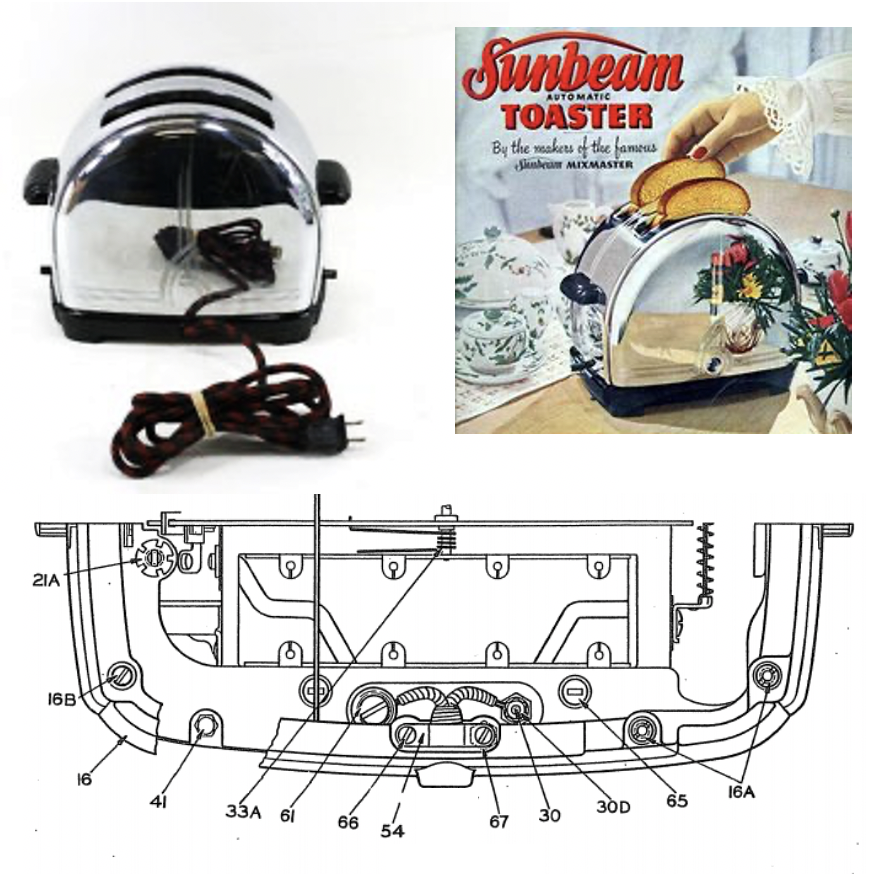
Alfonso Iannelli was right at home in the World of Tomorrow. Having gotten his start designing posters for vaudeville, Iannelli was also right at home with hype. Sunbeam Products was showcasing two of Iannelli’s designs: a toaster and a coffee pot, or the T-9 Toastmaster and C-20 Coffeemaster. These hardly seem innovative to today’s audience. But toasters were still an emerging tech in the 1930s. And the C-20 pioneered the vacuum coffee process which even today connoisseurs consider the superior way to make coffee.

Most importantly, the C-20 and T-9 brought the Streamline Moderne style to life. The push towards modernism was a recurring theme in Iannelli’s work. And there it was, at the World’s Fair, courtesy of Sunbeam.

Unified in style and updated in technology, these appliances have parallels in security capabilities. We’re often updating existing capabilities along with designing and implementing new ones. For example, suppose we have an existing workforce identity and access management program. Suppose we also have customer identities within the ecommerce website. A common challenge is to bring these two programs up-to-date and centralize the way identity is secured.

When developing a vision for the future, we naturally look for ways to implement the latest technology. It is equally important that we look for ways to standardize and unify the design for the experience.

Find the Streamline Moderne of identity and access management. First, find your vision.

After acclaim at the New York World’s Fair, Sunbeam put the coffee maker and toaster into production. The Coffeemaster would stay on the market nearly thirty years, wrapping up its run in 1964. Meanwhile? The Toastmaster was immortalized in a slice of Americana. On the cover of the Saturday Evening Post in 1948, central to the Norman Rockwell painting, there sat Alfonso Iannelli’s toaster. Moderne had arrived.

The starting point was the World of Tomorrow. Likewise, with your vision, the starting point is showcasing a pilot. Develop a proof-of-concept. Tie it to something larger. Hype it with all the gusto of a vaudeville poster.

Showcase your vision. Take this moment to gain early support and feedback.

Sunbeam T-9 Toastmaster, design by Alfonso Iannelli

This article is part of a series on designing cyber security capabilities. To see other articles in the series, including a full list of design principles, click here.
The IDEA Behind Simple Robots and Simple Security – Design Monday

October 12, 2020

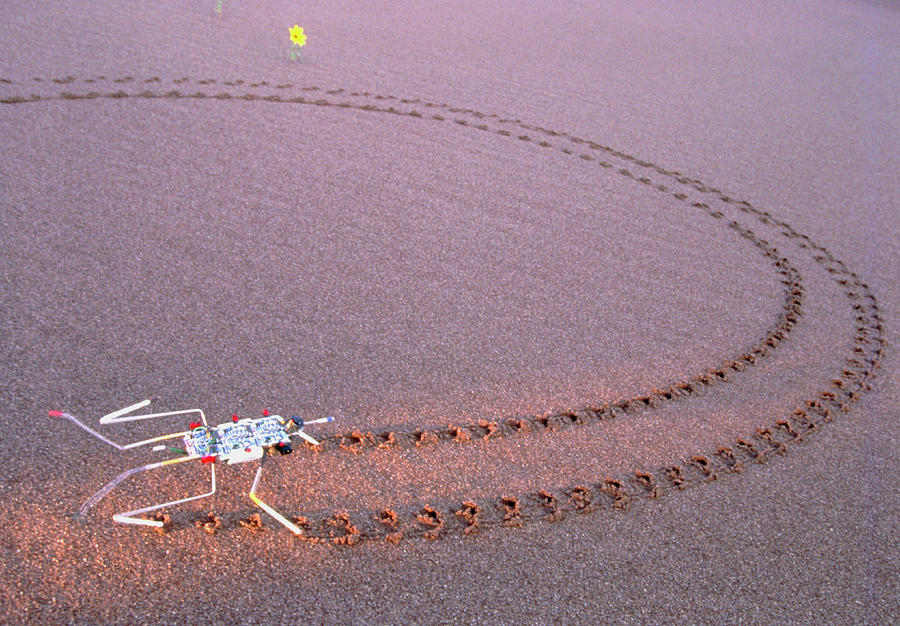
It was the early nineties when I first saw the photograph of a small robot wandering the desert. I would go on to buy the Robo Sapien book which featured photographs from the same shoot, along with more from Peter Menzel. Iconic. Simple. Inspiring and, most of all, achievable.

Robotics in the 1980s and 1990s were incredibly complex and costly. Significant computing power and sensor tech was needed to move a limb. The idea of walking robots was a dream, to some, a fantasy. Rodney Brooks had made some advances with Genghis and Attila. But these were still tens of thousands of dollars. Such robots were available to grad students and researchers, but out tantalizingly of reach for the rest of us.

Enter Mark Tilden. The robot in the Menzel’s photograph, and the rest of Tilden’s menagerie in the 1990s, had a price tag of a few hundred dollars. Many were built from scrap parts and recycled electronics. This allowed for rapid prototyping, which in turn facilitated rapid innovation. End result? Simple robots that worked. Inexpensive robots that walked.

The real lesson I took from Tilden, which I applied both when I built his style of robots and when I designed IT systems, was how to copy an idea. It works like this:

  • Identify the features are providing the value
  • Deconstruct those into underlying principles and tasks
  • Emulate those tasks using the people and technology you have on hand
  • Act on those tasks to reproduce the effect, prototype and iterate, to develop your own way of providing the value

Tilden called his process biomimicry because the stated goal was to mimic biological systems. More broadly, applying Tilden’s process to my framework, you can envision the steps as follows:

  • Identify = Insects walk with legs controlled by a core set of neurons oscillating in a loop
  • Deconstruct = an oscillator with feedback
  • Emulate = two, four, or six inverter oscillators, or in BEAM nomenclature, Bicore, Quadcore, or Hexcore
  • Act = Unibug 1.0, seen in the photograph below

I wager this is the same process Tilden used to build unthinkable robots for a fraction of the cost using parts he had lying around. Meanwhile, in security, we’re challenged to build security capabilities with little budget using what we have on hand. This is where my IDEA method shines.

Implementing any capability reference model or framework is beyond the capacity of most organizations. So? Don’t.

In October 2019, I was in Haifa visiting the Technion. There I saw robots which mimicked the snakes which populate the deserts of Israel. The same movements that facilitate movement through the deserts of Israel are useful in navigating the rubble of fallen buildings and industrial accidents, in order to find survivors. My mind was instantly transported back to Mark Tilden and his spare-part creatures. It struck me that Alon Wolf’s bio-inspired snakes are the technological children of Tilden’s early experiments.

By following a process that closely mirrors my IDEA model, the engineers at the Technion had created a simple, efficient, and focused device which literally saves lives. They identified an unlikely source of inspiration and deconstructed that down to its most iconic element: the serpentine wiggle. They iterated until they were able to emulate this wiggle. Then they put their invention into action: rescuing folks who would otherwise perish.

We can do the same thing in our cyber security work.

Select your reference model. (Say, for an Identity and Access Management or IAM platform.) Use the process above to see where the value is coming from. (Let’s say, on-boarding and off-boarding.) Deconstruct these down to a few core objectives. Then, see what’s available in your organization in terms of tools and techniques. Run inexpensive and quick pilots to try out the ideas and form a plan.

Don’t act on all the things. Act on the right things.

Mark Tilden’s Unibug, photography by Peter Menzel.

This article is part of a series on designing cyber security capabilities. To see other articles in the series, including a full list of design principles, click here.
Follow Signs of Friction to Find Security Champions – Design Monday

October 5, 2020

On a winter evening in 2014, Nikki Sylianteng got a parking ticket. It wasn’t a surprise. This was in LA where the city collects around $140 million from tickets annually. Sylianteng’s $95 parking ticket wasn’t significant and it wasn’t a surprise. But what happened next was.

When designing security capabilities, we have two aspects to consider:

• The paths people take to complete work – number of steps, familiarity, and friction of each step
• The choices people make during work – number of choices, predictability, and cognitive load

I argue that security can improve people’s work. Make it easier. Make it faster. I often get pushback on this argument, and for good reason. A very real problem is that security teams don’t have good visibility into the path and the choices. Even more worrisome, we don’t get good feedback when things are difficult or when security controls are making them worse.

Millions live in LA. Hundreds of thousands get tickets in LA. One person gave feedback with a solution.

Why? It is the same reason the workforce tolerates bad security controls: habituation. People get used it. They become blind to the annoyances along the path they have to take to complete their workflow. Listen for these tell-tale phrases:

• That’s just the way the world works
• We’ve always done it this way
• Things could be worse

That’s an indication of a workflow security may be to improve while increasing security. There lies habituation. There lies unnecessary steps or choices. There lies an opportunity to improve the path. But we need a partner on the inside, someone who can see beyond the habituation, someone who has what’s called beginner’s mind.

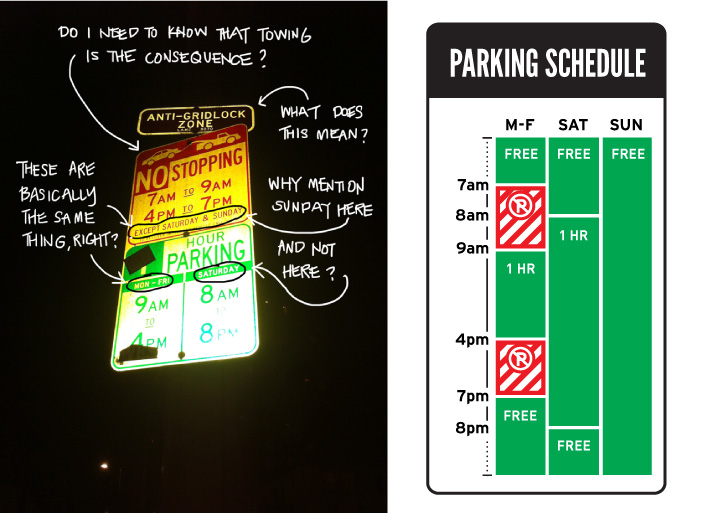
This is what drew me to the story of Sylianteng and her parking ticket. (Listen to Nikki Sylianteng tell her story herself here.) She didn’t accept the ticket. She couldn’t accept the way the parking signs were. She launched To Park or Not to Park and radically redesigned the parking signs. She has since created tools that anyone can use to create their own simplified parking signs.

Imagine our security goal is parking enforcement. Our control, the parking sign. Four million people in LA see the signs. Some follow them. Others don’t. Only one person actually says this is a problem, and takes it on themself to correct the problem. Do we embrace this person? Well. We should. According to Nikki Sylianteng, her new approach “has shown a 60% improvement in compliance and has pilots in 9 cities worldwide.”

Find those with a unique combination of beginner’s mind and desire to make a change. Embrace them. They are your security champions, and by working together, leaps in adoption and compliance are possible.

Before and after Nikki Sylianteng‘s parking sign redesign.

This article is part of a series on designing cyber security capabilities. To see other articles in the series, including a full list of design principles, click here.
TechRepublic: Four ways CISOs can move enterprise security into the new normal

September 29, 2020

Security is changing rapidly, and the COVID-19 pandemic hasn’t helped. A Cisco roundtable of chief information security officer advisers plotted the course for a secure future.

Excerpt from: Four ways CISOs can move enterprise security into the new normal

It’s time for collaboration, not control. CISOs can’t simply dictate security policy and expect users to fall in line. Not only will workers not fall in line with top-down security directives, they’re also likely to intentionally subvert them to get what they want out of the tech they use at work. “The more constraints placed on users, the more creative they become,” Goerlich said. Savvy users, Goerlich said, can be an asset to a cybersecurity team, helping to secure networks by collaborating with CISOs instead of working against them.

AI and machine learning: CISOs are right to be skeptical. “Training an AI model can take months,” Goerlich said, adding that a rapid change like the kind encountered with stay-at-home orders can throw machine learning models out the window. There were countless alerts and false positives thrown by AI-powered security software at the start of the pandemic, Goerlich said. 

It’s time to embrace a passwordless future. “Passwords have had their time. Nowadays attackers don’t break in, they log in,” Archdeacon said. Goerlich said the transition will be driven by two things: What users expect from consumer devices (e.g., FaceID, Microsoft Hello, etc.), and new security standards like FIDO2 that make passwordless security practical.

Read the full article: https://www.techrepublic.com/article/four-ways-cisos-can-move-enterprise-security-into-the-new-normal/

Wolf’s Additional Thoughts

I’ve taken to calling what happened in March and April as “the Spring when the AIs went insane.” Everyone shifted from working from the office to working from home, and then some shifted back when many were returning to the office. This occurred in three months. Typical general purpose UEBA takes 6-months or more to train. The result was a significant increase in false positives as the human response to the pandemic outstripped the UEBA AI/ML ability to learn. Everything was unusual. Everything was a threat. Everything generated an alert. In other words, the AIs went insane.


This post is an excerpt from a press article. To see other media mentions and press coverage, click to view the Media page or the News category. Do you want to interview Wolf for a similar article? Contact Wolf through his media request form.

Security is not the control, it is the context – Design Monday

September 28, 2020

Seeing is Forgetting the Name of the Thing One Sees. A fantastic title, right? I was having a coffee meeting with a new product designer a few months back. As can happen, I was pretty wound up, going on about the need for usability and human-centric design in cybersecurity. She told me, “you need to read Seeing is Forgetting the Name of the Thing One Sees.”

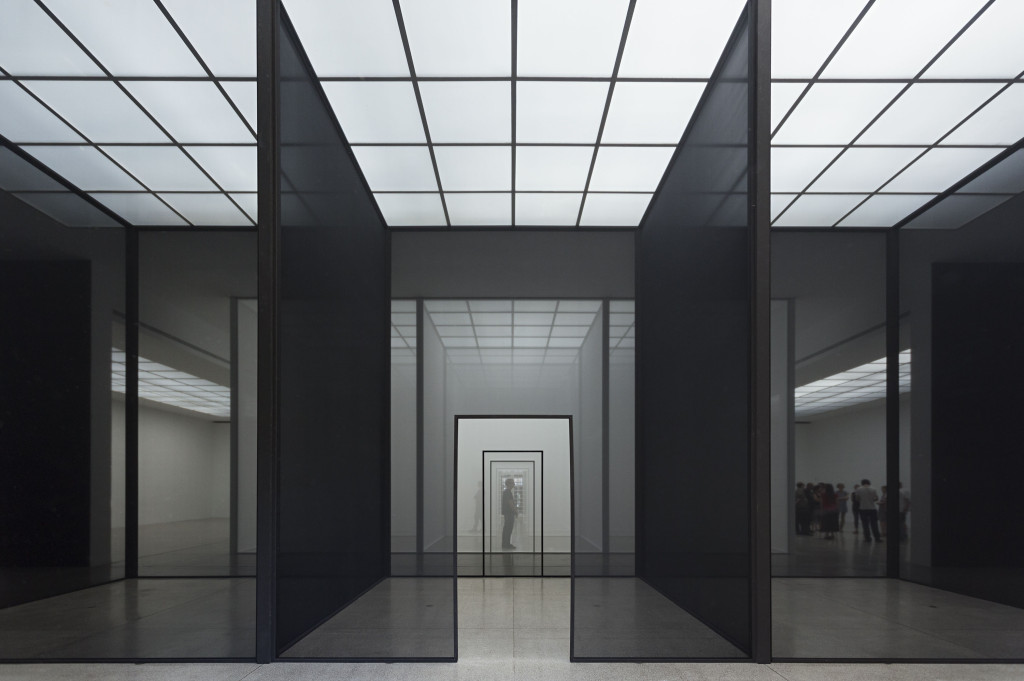
The book covers conversations Lawrence Weschler, the author, had over three time periods with Robert Irwin. It gets to the heard of Irwin’s philosophy and approach. Irwin began abstract in the 1960s. He painted lines. He painted dots. But when displaying his work, Irwin noticed the way the art was experienced was influenced by factors outside of his paintings. Any of us who have seen optical illusions with colors and lines understand this instinctively and likely think nothing of it. But to Irwin, who was obsessed with the experience to the point of banning photography, this simply wouldn’t do. Irwin took to replastering and repainting walls, sometimes whole studios, where his art was displayed.

Robert Irwin insisted on controlling the entire experience and this led to the realization that the surroundings were just as important as the artwork itself.

We’ve been slow at coming to a similar realization in cybersecurity. Consider the Web application. A thousand things have to go right for it to work, and a thousand things can go wrong from a security perspective. OWASP framed these issues up into a top 10 list. This simplified the work of developing a secure Web app. However, OWASP initially focused solely on the app itself.  Of the six releases since 2003, only the last two releases included the walls and studios, the vulnerable server components, on the OWASP top 10. We’re slow to recognize the importance of the surroundings.

Robert Irwin’s obsession with the surroundings transformed the artist from painter to landscaper. He has gone on to produce more than fifty large scale projects since 1975.

From the perspective of a designer, we must consider how the new capability fits into the existing cybersecurity portfolio and, more broadly, into the organization. We have to replaster the walls. We must make sure it fits in the studio. From the defensive perspective, this makes a lot of sense. A criminal faced with a strong control will look at the environment for other weaknesses and take advantage of gaps. From the usability perspective, Robert Irwin reminds us that how something is seen is as much about the thing as it is about the overall experience.

Security is not the control itself. Security is the surroundings.

Robert Irwin’s Double Blind exhibit at the Vienna Secession, Austria.
Photography: Philipp Scholz Ritterman

This article is part of a series on designing cyber security capabilities. To see other articles in the series, including a full list of design principles, click here.
The Work of Luck – Design Monday

September 21, 2020

It is the final task of an implementation. The stakes are high. One of your people hits a wrong button. The entire system comes crashing down. My question: Is this good luck, or bad?

For an answer and inspiration, I look to Massimo Bottura. Bottura is a chef and restauranter. At his Michelin 3-star restaurant, Osteria Francescana, a similar situation played out. The pastry chef, Taka Kondo, was platting the final course. One tart slipped. Smash! And to Kondo’s surprise and relief, Massimo Bottura burst out laughing. Good luck! The Oops! I dropped the lemon tart was born. The dessert has become legend.

You can hear Bottura tell the story himself at the video below. For now, I want to turn to the question of how to get lucky. So many things must go right when deploying technology, we can use all the luck we can get.

One factor in seeing the opportunity in accidents is associative barriers. High associative barriers lead to functional fixedness. By contrast, people with low associative barriers tend to find connections and opportunities others don’t. I’ve previously covered techniques to get beyond functional fixedness: discuss an item without naming it, and discussing what an item does rather than it is. (See Play with the spaces between the words.) Here, let’s cover building new associations.

New associations can prime us to turn accidents into good luck. It provides a larger net for catching ideas. The exercise is simple. List the assumptions. Imagine what would happen if the opposite were true. We can (and probably should) do this at multiple stages in designing security capabilities; from the vision to our assumptions about the organization, the security function, the security controls, the tools, and our assumptions about implementation. For example:

  • A tart from a Michelin 3-star restaurants is carefully plated and perfectly constructed.
    • It is messily deconstructed. Innovation: Oops! I dropped the lemon tart.
  • The authenticating security credential is a person’s ID and password.
    • A person can authenticate without a password. Innovation: passwordless.
  • A security perimeter is enforced by the network, that is, by a firewall.
    • A perimeter is enforced regardless of network. Innovation: Zero Trust.
  • Defense-in-depth necessarily means having deep control coverage.
    • Defense can be achieved with only a few controls. Innovation: attack path.

The other factor in finding the opportunity in accidents is time. Rushed people don’t get lucky. Stressed people don’t get opportunities. The psychology of stress and time shows people develop tunnel vision and repeat well-known and practiced techniques. The same is equally true for rushed and stressed projects and initiatives. The same goes for rushed and stressed teams and operations. This is an anathema to getting lucky, of course. We’re highly unlikely to see possibilities and to take them on when in this state. Buffer time and down time create the space for getting lucky.

“Leave a free space for poetry. Leave a free space from obligation. You have to be ready to see what others don’t even imagine,” Massimo Bottura says in the video below. He could be speaking directly to us about designing security capabilities. “Make visible the invisible.”

Massimo Bottura tells the story behind Oops! I dropped the tart.

This article is part of a series on designing cyber security capabilities. To see other articles in the series, including a full list of design principles, click here.

Mies and IBM Plaza: Knowing When More is More – Design Monday

September 14, 2020

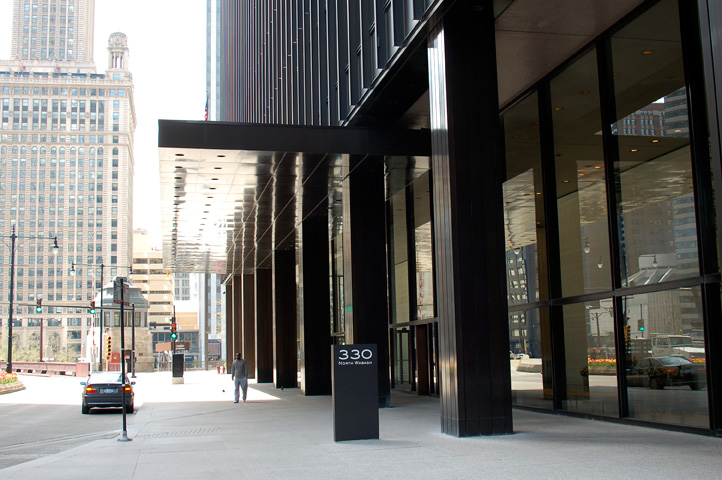
The building came into view. My vantage point was on the Chicago River. It was Valentine’s Day. Now Chicago natives had warned us about the cold February winds. But there my wife and I were, on a river tour of Chicago’s architecture. Frozen to the ship’s deck, we looked up as the IBM Plaza came into view.

Ludwig Mies van der Rohe designed the building in the 1960s. Mies came from the famed Bauhaus school, another of my favorite sources of inspiration. In fact, Mies was the last director of Bauhaus. He moved from Berlin to Chicago in 1937 to head the architecture department of Illinois Institute of Technology. There’s a direct line from Bauhaus to Second Chicago School of architecture. Specifically, in minimizing ornamentation in favor of emphasizing building materials themselves.

It was this modernism which drew IBM to Mies van der Rohe. But there was a problem. Many, in fact, with the building IBM wanted. Computing technology of that age was notoriously hot and power-hungry. Moreover, computer engineers were at a premium, which meant a large workforce with little patience for waiting on elevators. Every minute counted. Moving to the ground, the lot was an oddly shaped. Triangular. It sat partially atop of a train line which restricts the foundation needed for a skyscraper. And to top it off, the site had an agreement to provide storage for the Sun-Times. That’s a lot.

“Less is more” was popularized by Mies van der Rohe. Boil down architectural requirements to the essentials. In cybersecurity, we’ve embraced less is more. You see it in concepts like least privilege, least trust (aka Zero Trust), economy of mechanism, and limited security blast radius. You see it in my security principles; like when I discuss building Roombas not Rosies. Less is more is a reminder to take a minimalist approach.

Even from the Chicago River, you can feel the minimalism of the IBM Plaza. The exposed vertical beams, the glass and steel materials on full display. Less is more. But it’s more than it seems. The building has more than double the elevators of a comparable building. The cooling system is similarly over-powered. Designed by C.F. Murphy, the HVAC is tuned for 1970s era computing. Mies also made several floors to be taller to support raised flooring, and reinforced to support the weight. The building is subtly shifted back to make use of the lot, with weight shifted back onto a strong foundation. This feature explains the open pillars in front and allowed Meis to neatly avoid the question of the railway. Less is more? If anything, much of the IBM building is overdone.

Less is more is not a call for doing less. It is a reminder to save our energies to do more where it counts. It is a reminder to pour the savings into solutions for the problem at hand. When we save resources for priorities, less isn’t loss.

IBM moved into IBM Plaza in 1971. For more than three decades, the building was the Chicago office of the tech giant. “The building was declared a Chicago Landmark on February 6, 2008 and added to the National Register of Historic Places on March 26, 2010.” Today, the building at 330 North Wabash is known as the AMA Plaza. It stands as a testament to Ludwig Mies van der Rohe’s ability to balance less and more.

The design lesson: More of what matters is more.

The floating foundation of 330 North Wabash, Chicago. Photography by Ryan Cramer.

This article is part of a series on designing cyber security capabilities. To see other articles in the series, including a full list of design principles, click here.

Build Roombas not Rosies – Design Mondays

September 7, 2020

The Jetsons debuted this month in 1962. The cartoon depicted a family living a hundred years in the future, 2062. The swooping architectural style, with the quite fun name Googie, serves as the visual language of the future in shows from The Incredibles to Futurama. The everyday gadgetry in the Jetsons foreshadows today’s drones, holograms, moving walkways and stationary treadmills, flat screen televisions, tablet computers, and smart watches.

Remember color television was on the very cutting edge of technology when The Jetsons debuted. This list is impressive. But that smart watch? That last one wasn’t by accident.

The dominant smart watch in 2020 is the Apple Watch, designed by Marc Newson and Jony Ive. In an interview with the New York Times, Marc Newson explained his fascination with the Jetsons lead him into the world of design. “Modernism and the idea of the future were synonymous with the romance of space travel and the exotic materials and processes of space technology. Newson’s streamlined aesthetic was influenced by his Jetsonian vision of the future.” I imagine the first time Newson FaceTimed Jony Ive on an Apple Watch, they felt the future had finally arrived.

Designing the future has constraints that imagining the future lacks.

For starters, people and culture constrain innovation. Consider George and his flying car, Elroy and his jetpack, and space tourism. All these are technically feasible in 2020. But I wouldn’t trust a young boy with a jetpack, nor would most of us have money for a trip to the moon. Another constraint is technical complexity. Sure, we have talking dogs. But the reality is much different from the Jetson’s Astro. And yes, we have AI and robotics. But Siri is no R.U.D.I.

When designing future security capabilities and controls, we need to identify and quantify the constrains. One technique for this is the Business Transformation Readiness Assessment. Evaluate factors such as:

  • Desire, willingness, and resolve 
  • IT capacity to execute
  • IT ability to implement and operate
  • Organizational capacity to execute
  • Organizational ability to implement and operate
  • More factors here: https://pubs.opengroup.org/…/chap26.html

With this evaluation, we can rank what’s feasible against what’s needed. We can act on areas with momentum (desire, willingness, resolve) and build capabilities that can be maintained. But! There’s one additional step.

We don’t need a robot to push around a vacuum when we have a robot vacuum. We don’t need a full AI/ML deep learning platform when we can have a well-tuned SIEM. Implement security in a minimum viable way.

Identify the constraints. Select the security capability the organization is most ready for. Then build Roombas, not Rosies.

Rosie the Robot, The Jetsons, Photography by Brilux.

This article is part of a series on designing cyber security capabilities. To see other articles in the series, including a full list of design principles, click here.

Make Security an Inside Job – Design Monday

August 31, 2020

We landed a man on the moon before we had wheeled suitcases. Wait. I’ll do one better. We were orbiting space shuttles before we had wheeled suitcases. I heard this fact years ago and it blew me away. I asked, why?

It took an inside guy solving his problem his way. Picture modern travel luggage. Wheels on the bottom, telescoping handle on the top, right? Robert Plath invented this in 1987 in outside of his day job as a Northwest Airlines pilot. (United States patent 4,995,487, if you’re interested.) It was a classic garage inventor success story. Plath developed and tested the prototypes, the idea took off, and he founded Travelpro and began selling the suitcases under the label Rollaboard.

The first design lesson: the person doing the job is the right person to ask about how to improve the job. Good security is usable security.

A while back, I was consulting on a privileged access management (PAM) security capability. The security objective was that all administration be performed from a dedicated laptop, using a separate credentials, through sessions that were monitored and recorded. Try selling that level of control, that level of friction, and that level of change to the administrators. Yeah. Good luck with that approach.

Instead, we found the Robert Plath of systems administration. Instead of pitching security, we asked him how heavy his bags were to carry. The team approached PAM as an admin productivity project. Wheels on bottom. Telescoping handle on top. The resulting privileged access workstations (PAWs) reduced access time and simplified systems administration tasks. While the PAM controls added friction, due to the insights and efforts of Plath the systems admin, these were offset by time savings. This is the inside edge that collaboration can bring.

Returning to the actual Robert Plath, there’s one more lesson in designing capabilities. Surely, you must be thinking, other people thought to add wheels to suitcases in the first six decades of commercial air travel. You’re right. Bernard Sadow came up with a design decades before Plath. (United States patent 3,653,474, again, if you’re interested.) It’s effectively a traditional suitcase with castors on one side. I have one. Let’s just say it isn’t the easiest luggage to use. But that wasn’t the main problem. Adoption and culture was.

Bernard Sadow made luggage. Robert Plath flew planes. Sadow had to sell into the market. This ran into cultural issues because, back then, one sure way to show your strength as a man was to carry luggage. Plath just handed his prototypes to flight crews. Not only was Plath’s luggage better, suddenly, it was the cool kids’ luggage. In other words, Sadow pitched safety glasses and Plath offered Ray-Bans.

The final design lesson is planning for adoption is planning for success. Good security takes flight when widely adopted.


This article is part of a series on designing cyber security capabilities. To see other articles in the series, including a full list of design principles, click here.